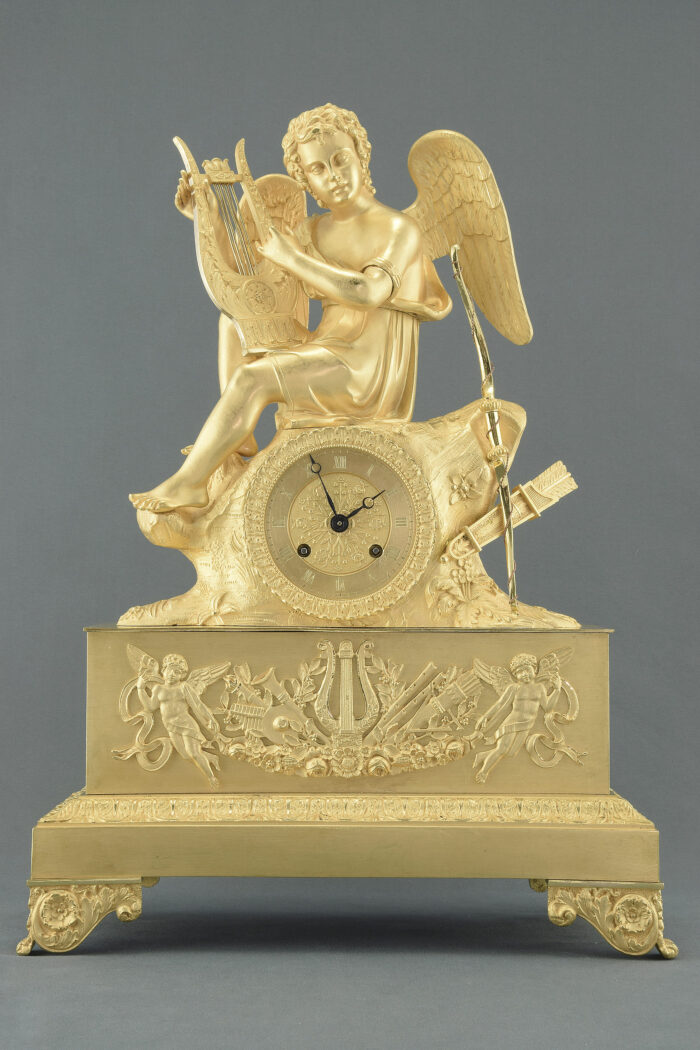
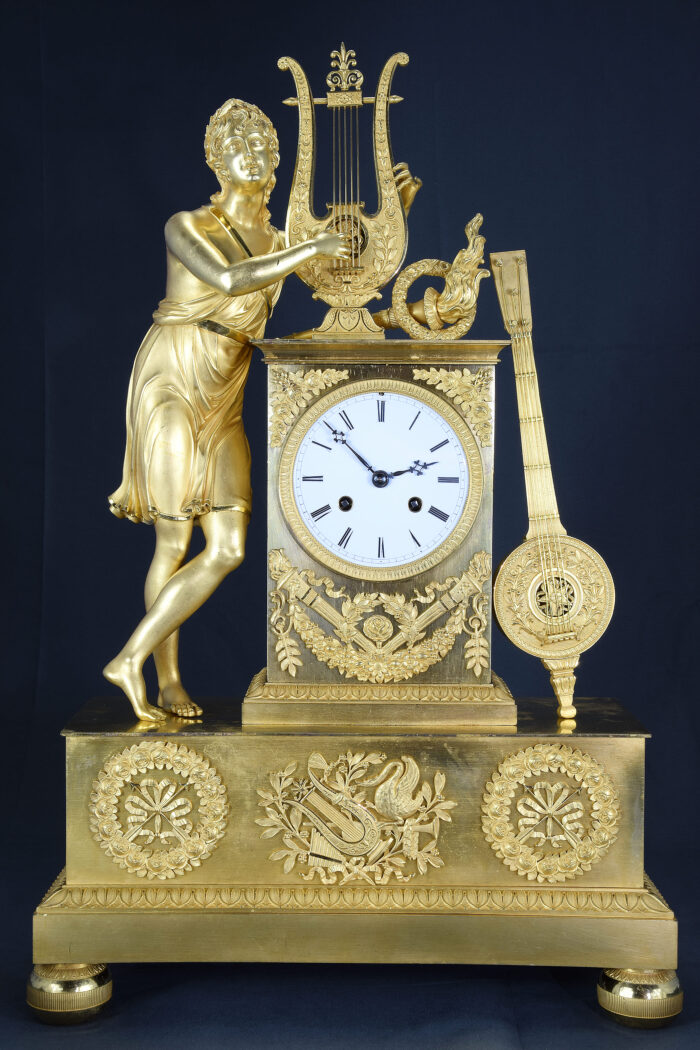
A superb Charles X period clock, circa 1840, brilliantly illustrating all the refinement and craftsmanship of the great French tradition. Made of finely chased bronze and mercury-gilded with gold, it is distinguished by the exceptional quality of its gilding, with a warm and deep shine. The dial and the mechanism are signed by the bronze craftsman and the clockmaker, both listed in Tardy, the dictionary of French clockmakers, guaranteeing an authentic and sought-after provenance.
The sculpture at the top, depicting Venus at her bath, is exquisitely delicate. Gracefully seated on a tortoise, she adopts a posture that is both modest and sensual, her legs folded, her torso slightly inclined in a natural and fluid movement. Her arm lightly touches her hair in an intimate and timeless gesture, while her softly featured face expresses a dreamy serenity. Her gaze, slightly averted, evokes both modesty and an awareness of her beauty. The tortoise, a symbol of slowness and stability, reinforces the idea of a suspended moment, almost timeless, accentuating the allegorical dimension of the scene.
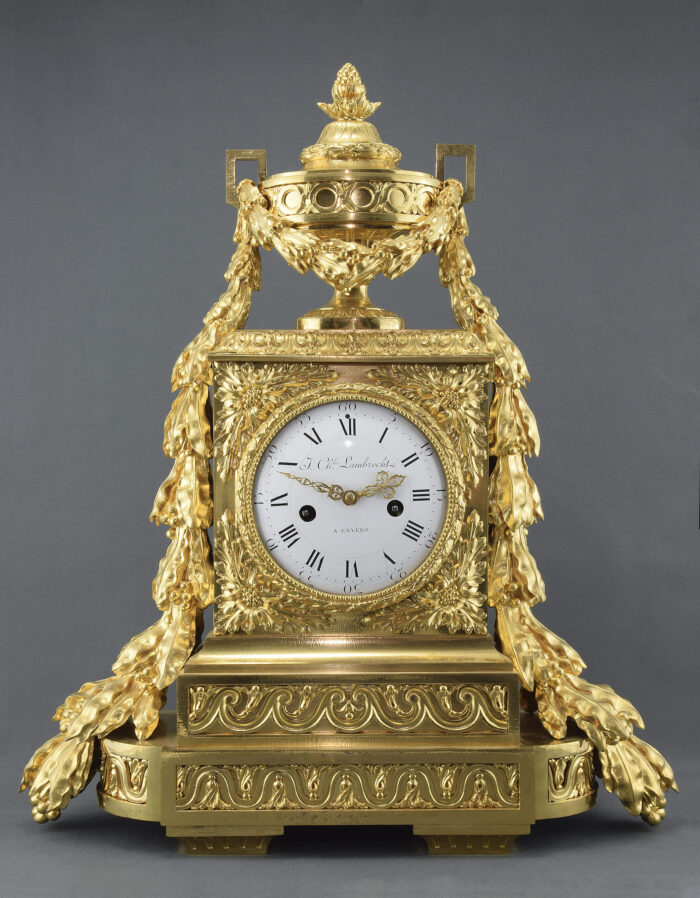
The clock's body adopts a simple and elegant design, highlighting a circular dial with Roman numerals, framed by a finely chiseled twisted frieze. The white enamel dial, punctuated by delicate hands, is set within a richly ornamented background of floral garlands and applied naturalistic motifs. The stepped base is embellished with palmette friezes, scrolls, and raised plant motifs, demonstrating particularly meticulous chiseling. The whole rests on foliate scroll feet, lending stability and elegance to this harmonious and refined composition.
Ultimately, this clock perfectly…
A superb Charles X period clock, circa 1840, brilliantly illustrating all the refinement and craftsmanship of the great French tradition. Made of finely chased bronze and mercury-gilded with gold, it is distinguished by the exceptional quality of its gilding, with a warm and deep shine. The dial and the mechanism are signed by the bronze craftsman and the clockmaker, both listed in Tardy, the dictionary of French clockmakers, guaranteeing an authentic and sought-after provenance.
The sculpture at the top, depicting Venus at her bath, is exquisitely delicate. Gracefully seated on a tortoise, she adopts a posture that is both modest and sensual, her legs folded, her torso slightly inclined in a natural and fluid movement. Her arm lightly touches her hair in an intimate and timeless gesture, while her softly featured face expresses a dreamy serenity. Her gaze, slightly averted, evokes both modesty and an awareness of her beauty. The tortoise, a symbol of slowness and stability, reinforces the idea of a suspended moment, almost timeless, accentuating the allegorical dimension of the scene.
The clock's body adopts a simple and elegant design, highlighting a circular dial with Roman numerals, framed by a finely chiseled twisted frieze. The white enamel dial, punctuated by delicate hands, is set within a richly ornamented background of floral garlands and applied naturalistic motifs. The stepped base is embellished with palmette friezes, scrolls, and raised plant motifs, demonstrating particularly meticulous chiseling. The whole rests on foliate scroll feet, lending stability and elegance to this harmonious and refined composition.
Ultimately, this clock perfectly embodies the union of neoclassical taste and 19th-century French craftsmanship. With its remarkable gilding, exquisite chasing, and elegant sculptural composition, this clock stands out as both a decorative and precious piece. A true work of art as well as a timepiece, it will appeal to discerning collectors and lovers of exceptional objects alike, bringing a touch of distinction, poetry, and timeless prestige to any interior.
Original movement intact and unaltered, with silk-thread suspension. Striking on the hours and half-hours on an antique bell, producing a clear and authentic tone.
This website uses cookies to ensure you get the best experience on our website.
Functional Always active
The technical storage or access is strictly necessary for the legitimate interest purpose of enabling the use of a specific service explicitly requested by the subscriber or user, or for the sole purpose of carrying out the transmission of a communication over an electronic communications network.
Preferences
The technical storage or access is necessary for the legitimate purpose of storing preferences that are not requested by the subscriber or user.
Statistiques
The technical storage or access that is used exclusively for statistical purposes.Le stockage ou l’accès technique qui est utilisé exclusivement à des fins statistiques anonymes. En l’absence d’une assignation à comparaître, d’une conformité volontaire de la part de votre fournisseur d’accès à internet ou d’enregistrements supplémentaires provenant d’un tiers, les informations stockées ou extraites à cette seule fin ne peuvent généralement pas être utilisées pour vous identifier.
Marketing
The technical storage or access is required to create user profiles in order to send advertising, or to track the user on a website or across several websites for similar marketing purposes.


 Discover this piece
 Discover this piece
 Discover this piece
 Discover this piece
 Discover this piece
 Discover this piece
 Discover this piece
 Discover this piece
 Discover this piece
 Discover this piece
 Discover this piece
 Discover this piece
 Discover this piece
 Discover this piece
 Discover this piece