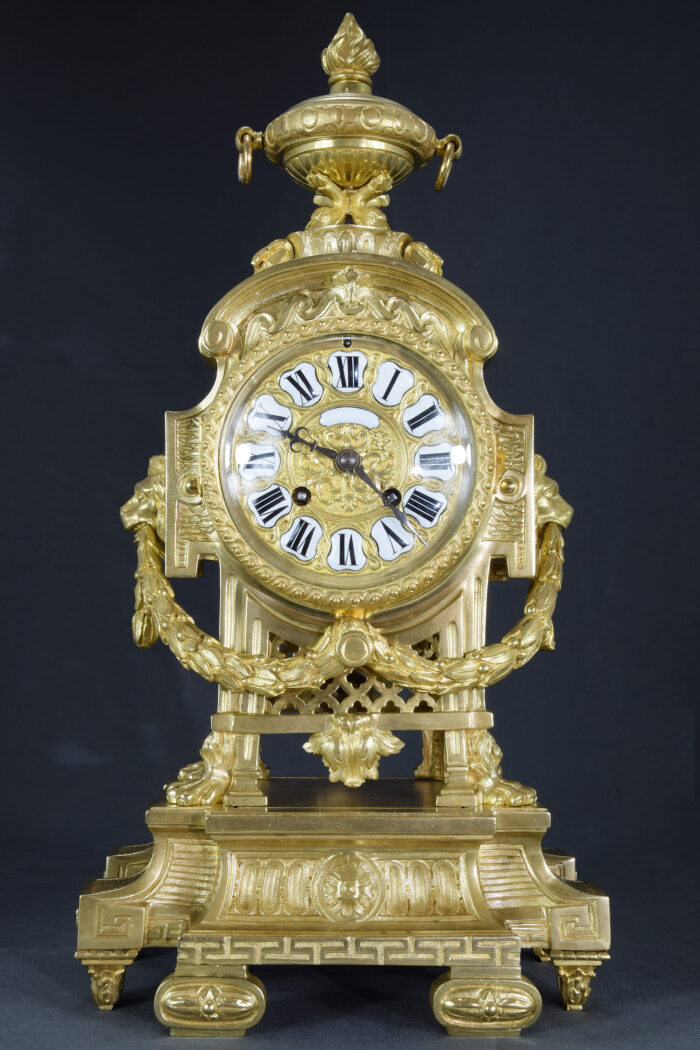
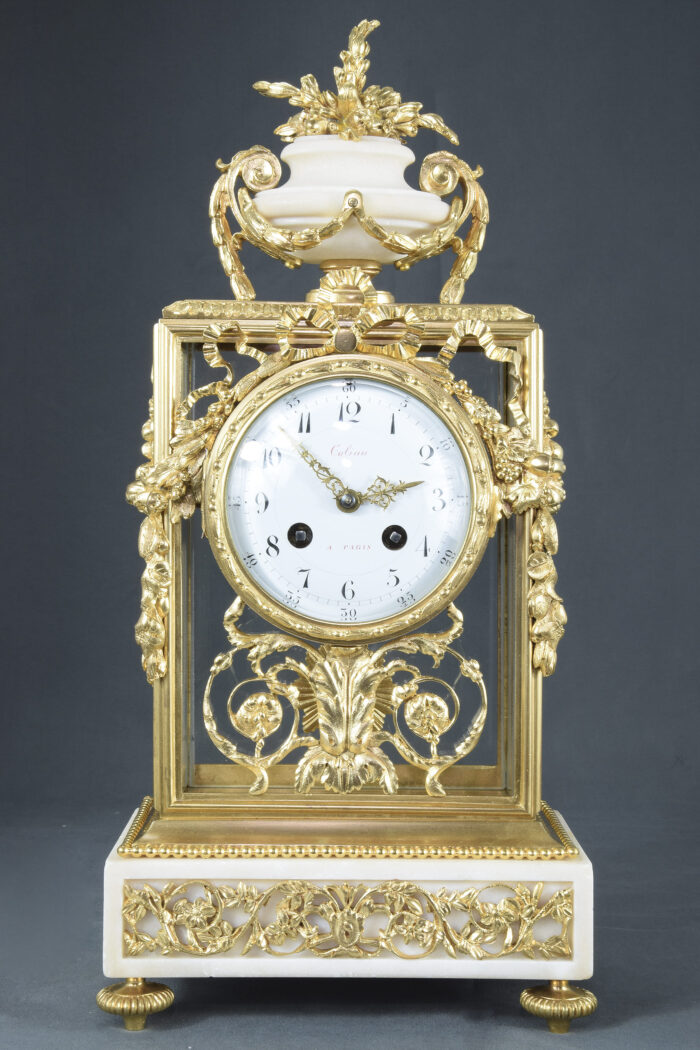
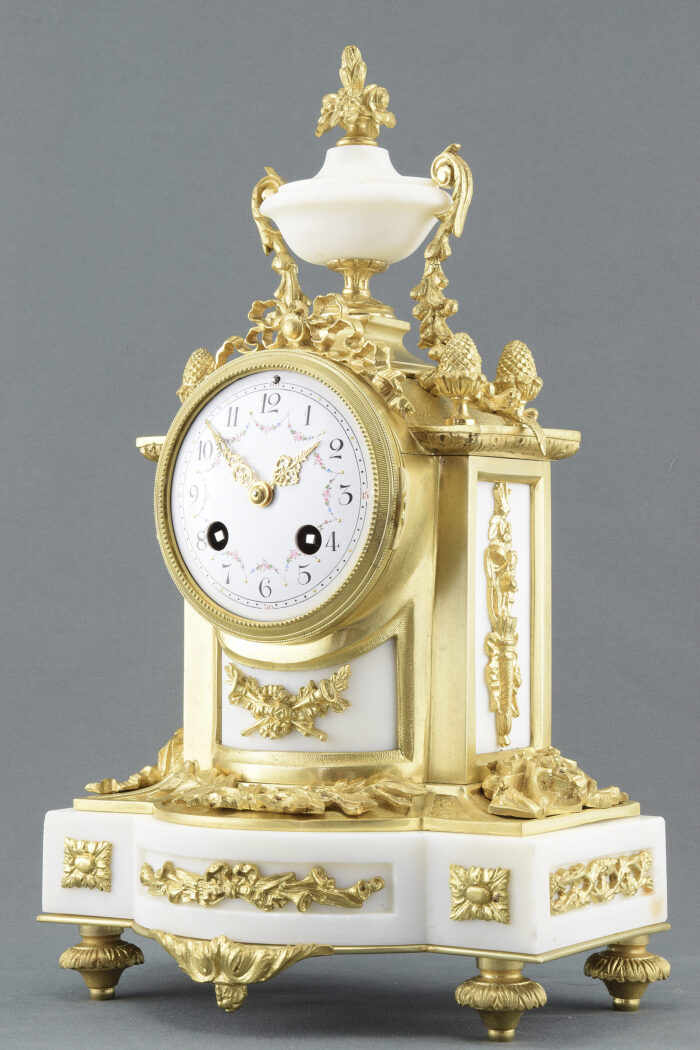
The imposing scale, authenticity and remarkable state of preservation of this Louis XVI mantel clock make it a piece of exceptional rarity. Dating from around 1780, its finely chased, mercury-gilt bronze case combines the architectural discipline of classical design with the graceful sweep of long foliate garlands. The gold catches the light on every detail, from the delicate veins of the leaves to the broad mouldings of the plinth.
A covered urn on a pedestal crowns the case. Two angular handles frame the urn, and a pine-cone finial rises from its lid. A garland of leaves and berries hangs in a graceful swag between the handles. On either side, long cascades of foliage follow the contours of the case before sweeping out beyond the plinth, giving the clock its distinctive silhouette. Two bands of running-scroll ornament echo one another across the stepped base and around its curved ends.
At the centre of the case, the white enamel dial stands out against a finely worked bronze ground. A beaded bezel framed by foliage surrounds the dial, with a floral ornament in each corner. Two gilt hands, delicately pierced and chased, indicate the hours in Roman numerals and the minutes at five-minute intervals in Arabic numerals. Above the hands’ central pivot is the signature “J. Chˡᵉˢ. Lambrecht”. The inscription “A ENVERS” appears below.
The signature links the clock to a family of clockmakers established in Antwerp in the 18th century. Their surname is recorded as Lambrechts, while the dial bears the spelling Lambrecht. The father, Jan Carel Lambrechts, also recorded as Joannes Carolus Lambrechts and known in French as Jean-Charles Lambrechts, was admitted as a master…
The imposing scale, authenticity and remarkable state of preservation of this Louis XVI mantel clock make it a piece of exceptional rarity. Dating from around 1780, its finely chased, mercury-gilt bronze case combines the architectural discipline of classical design with the graceful sweep of long foliate garlands. The gold catches the light on every detail, from the delicate veins of the leaves to the broad mouldings of the plinth.
A covered urn on a pedestal crowns the case. Two angular handles frame the urn, and a pine-cone finial rises from its lid. A garland of leaves and berries hangs in a graceful swag between the handles. On either side, long cascades of foliage follow the contours of the case before sweeping out beyond the plinth, giving the clock its distinctive silhouette. Two bands of running-scroll ornament echo one another across the stepped base and around its curved ends.
At the centre of the case, the white enamel dial stands out against a finely worked bronze ground. A beaded bezel framed by foliage surrounds the dial, with a floral ornament in each corner. Two gilt hands, delicately pierced and chased, indicate the hours in Roman numerals and the minutes at five-minute intervals in Arabic numerals. Above the hands’ central pivot is the signature “J. Chˡᵉˢ. Lambrecht”. The inscription “A ENVERS” appears below.
The signature links the clock to a family of clockmakers established in Antwerp in the 18th century. Their surname is recorded as Lambrechts, while the dial bears the spelling Lambrecht. The father, Jan Carel Lambrechts, also recorded as Joannes Carolus Lambrechts and known in French as Jean-Charles Lambrechts, was admitted as a master clockmaker in Antwerp on 19 November 1759. He held the title of clockmaker to Duke Charles of Lorraine, who owned three clocks by his hand.
His son, Joannes Carolus Lambrechts, likewise known in French as Jean-Charles Lambrechts, was born in 1759 and was admitted as a master clockmaker in Antwerp on 18 February 1782. Both masters worked in the same city and shared the same given names. The dial signature alone therefore leaves the attribution to father or son open.
Original movement intact and unaltered, with silk-thread suspension. Striking on the hours and half-hours on an antique bell, producing a clear and authentic tone.
This website uses cookies to ensure you get the best experience on our website.
Functional Always active
The technical storage or access is strictly necessary for the legitimate interest purpose of enabling the use of a specific service explicitly requested by the subscriber or user, or for the sole purpose of carrying out the transmission of a communication over an electronic communications network.
Preferences
The technical storage or access is necessary for the legitimate purpose of storing preferences that are not requested by the subscriber or user.
Statistiques
The technical storage or access that is used exclusively for statistical purposes.Le stockage ou l’accès technique qui est utilisé exclusivement à des fins statistiques anonymes. En l’absence d’une assignation à comparaître, d’une conformité volontaire de la part de votre fournisseur d’accès à internet ou d’enregistrements supplémentaires provenant d’un tiers, les informations stockées ou extraites à cette seule fin ne peuvent généralement pas être utilisées pour vous identifier.
Marketing
The technical storage or access is required to create user profiles in order to send advertising, or to track the user on a website or across several websites for similar marketing purposes.

 Discover this piece
 Discover this piece
 Discover this piece
 Discover this piece
 Discover this piece
 Discover this piece
 Discover this piece
 Discover this piece
 Discover this piece
 Discover this piece
 Discover this piece
 Discover this piece
 Discover this piece
 Discover this piece
 Discover this piece