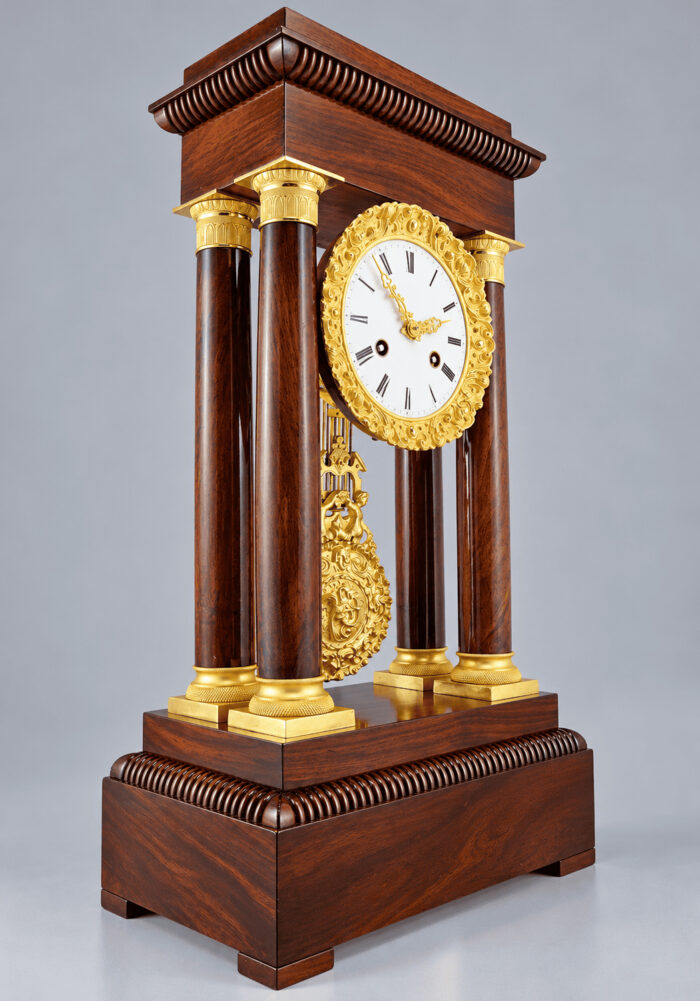
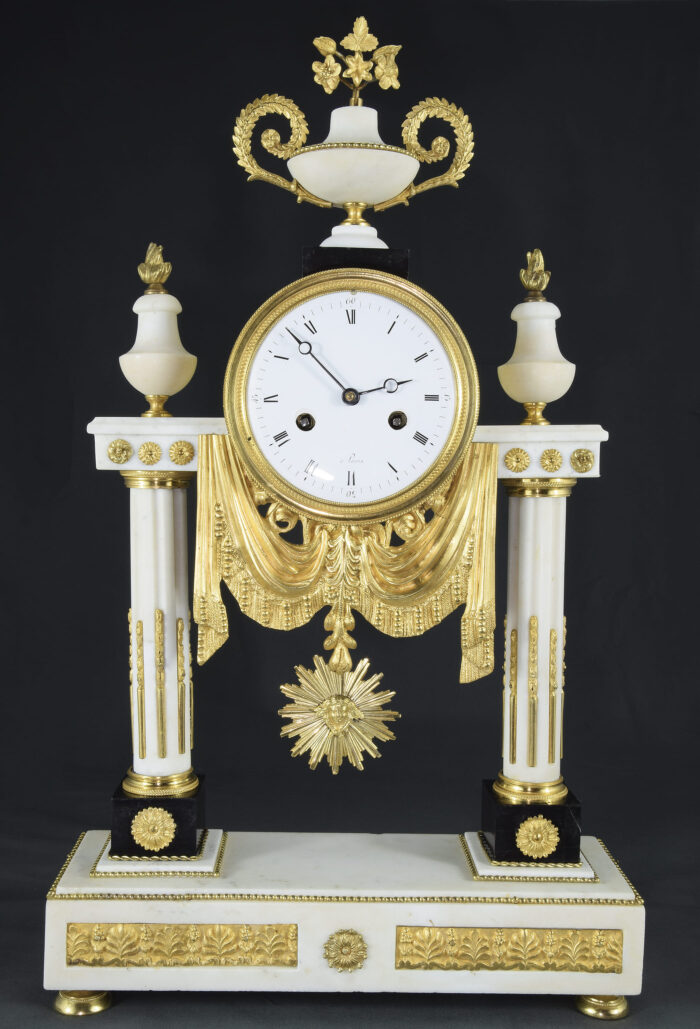
An exceptional Empire-period portico clock, created circa 1810, this elegant masterpiece superbly illustrates, with rare refinement, the monumental and solemn aesthetic of the decorative arts of the First Empire. Its architecture, remarkable for the purity of its classical lines, is entirely crafted from white marble, whose luminous softness contrasts magnificently with the sumptuous ornamentation of finely chased and mercury-gilt bronze. The harmony of its proportions, the nobility of its materials and the particularly meticulous quality of its execution endow this clock with a presence that is both majestic and delicate.
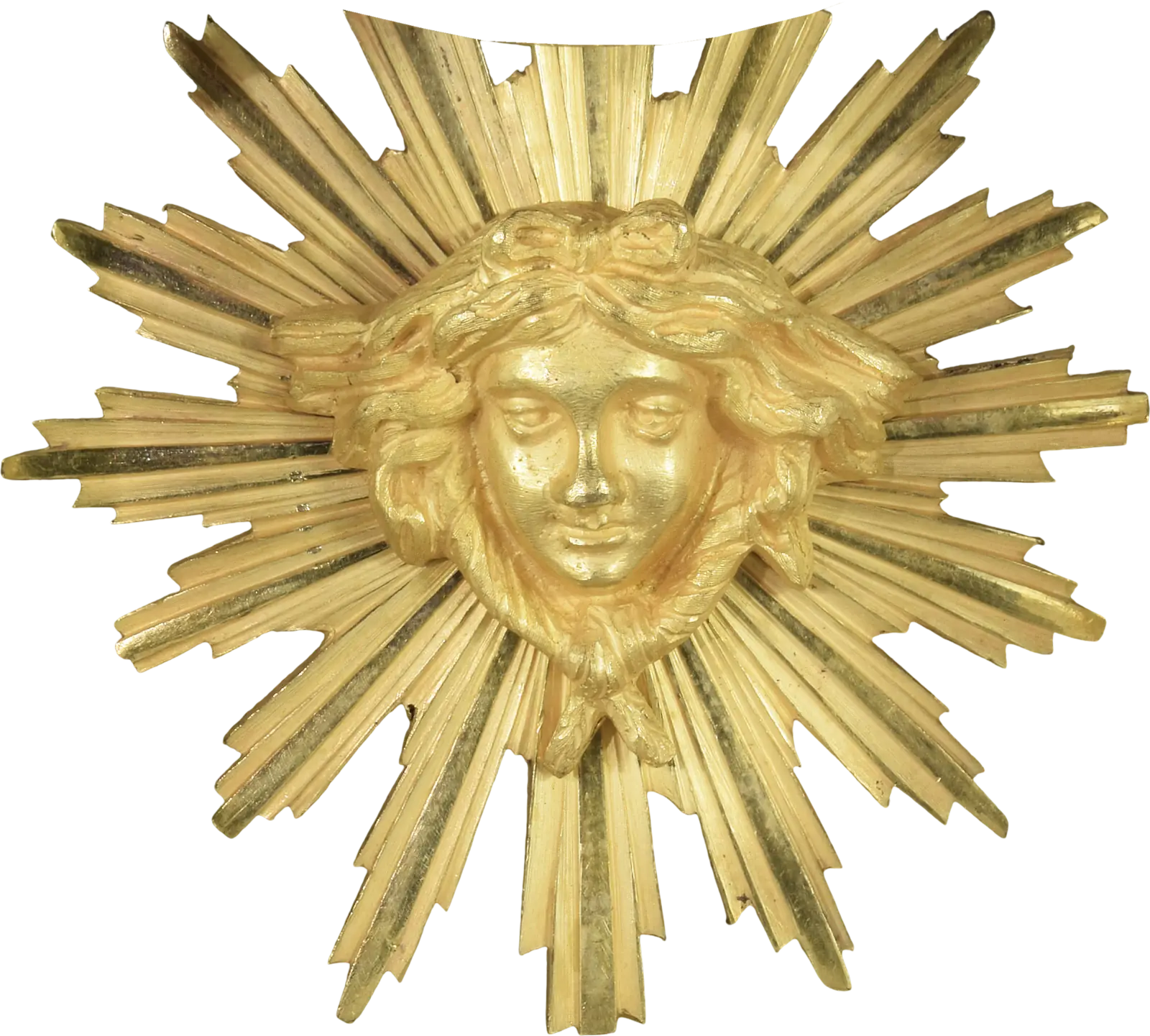
The composition is distinguished by an imposing curved pediment in white marble, enhanced with architectural mouldings and flanked by two elegant entablatures surmounted by antique-style gilt-bronze vases. Four slender cylindrical columns support the structure, resting upon square bases enriched with finely chased bands and mouldings. At the centre, the movement is majestically suspended within a remarkable circular gilt-bronze surround, delicately decorated with friezes, beadwork and ornamental motifs. The white dial with Roman numerals is framed by a richly sculpted bezel and surmounted by a spectacular netted drapery, rendered in gilt bronze with remarkable virtuosity in imitation of textile, its fringes falling with striking naturalism. Beneath the ensemble, the pendulum, animated by a radiant sun with a human face, brings a poetic and symbolic touch to this composition of great elegance.
An authentic testament to the decorative arts of the Empire period, this portico clock is as captivating for the rigour of its neoclassical architecture as for…
An exceptional Empire-period portico clock, created circa 1810, this elegant masterpiece superbly illustrates, with rare refinement, the monumental and solemn aesthetic of the decorative arts of the First Empire. Its architecture, remarkable for the purity of its classical lines, is entirely crafted from white marble, whose luminous softness contrasts magnificently with the sumptuous ornamentation of finely chased and mercury-gilt bronze. The harmony of its proportions, the nobility of its materials and the particularly meticulous quality of its execution endow this clock with a presence that is both majestic and delicate.
The composition is distinguished by an imposing curved pediment in white marble, enhanced with architectural mouldings and flanked by two elegant entablatures surmounted by antique-style gilt-bronze vases. Four slender cylindrical columns support the structure, resting upon square bases enriched with finely chased bands and mouldings. At the centre, the movement is majestically suspended within a remarkable circular gilt-bronze surround, delicately decorated with friezes, beadwork and ornamental motifs. The white dial with Roman numerals is framed by a richly sculpted bezel and surmounted by a spectacular netted drapery, rendered in gilt bronze with remarkable virtuosity in imitation of textile, its fringes falling with striking naturalism. Beneath the ensemble, the pendulum, animated by a radiant sun with a human face, brings a poetic and symbolic touch to this composition of great elegance.
An authentic testament to the decorative arts of the Empire period, this portico clock is as captivating for the rigour of its neoclassical architecture as for the extraordinary finesse of its gilt bronzes. The immaculate whiteness of the marble, the warm radiance of the mercury gilding and the richness of the decoration create a contrast of rare sophistication. With its imposing proportions, its remarkable aesthetic condition and the exceptional quality of its decorative details, this clock is a particularly compelling work, capable of commanding a mantelpiece, console table or prestigious interior with great majesty. A true work of art, in which architectural beauty meets the virtuosity of the French bronziers of the early 19th century.
Original movement intact and unaltered, with silk-thread suspension. Striking on the hours and half-hours on an antique bell, producing a clear and authentic tone.
This website uses cookies to ensure you get the best experience on our website.
Functional Always active
The technical storage or access is strictly necessary for the legitimate interest purpose of enabling the use of a specific service explicitly requested by the subscriber or user, or for the sole purpose of carrying out the transmission of a communication over an electronic communications network.
Preferences
The technical storage or access is necessary for the legitimate purpose of storing preferences that are not requested by the subscriber or user.
Statistiques
The technical storage or access that is used exclusively for statistical purposes.Le stockage ou l’accès technique qui est utilisé exclusivement à des fins statistiques anonymes. En l’absence d’une assignation à comparaître, d’une conformité volontaire de la part de votre fournisseur d’accès à internet ou d’enregistrements supplémentaires provenant d’un tiers, les informations stockées ou extraites à cette seule fin ne peuvent généralement pas être utilisées pour vous identifier.
Marketing
The technical storage or access is required to create user profiles in order to send advertising, or to track the user on a website or across several websites for similar marketing purposes.

 Discover this piece
 Discover this piece
 Discover this piece
 Discover this piece
 Discover this piece
 Discover this piece
 Discover this piece
 Discover this piece
 Discover this piece
 Discover this piece
 Discover this piece
 Discover this piece
 Discover this piece
 Discover this piece
 Discover this piece