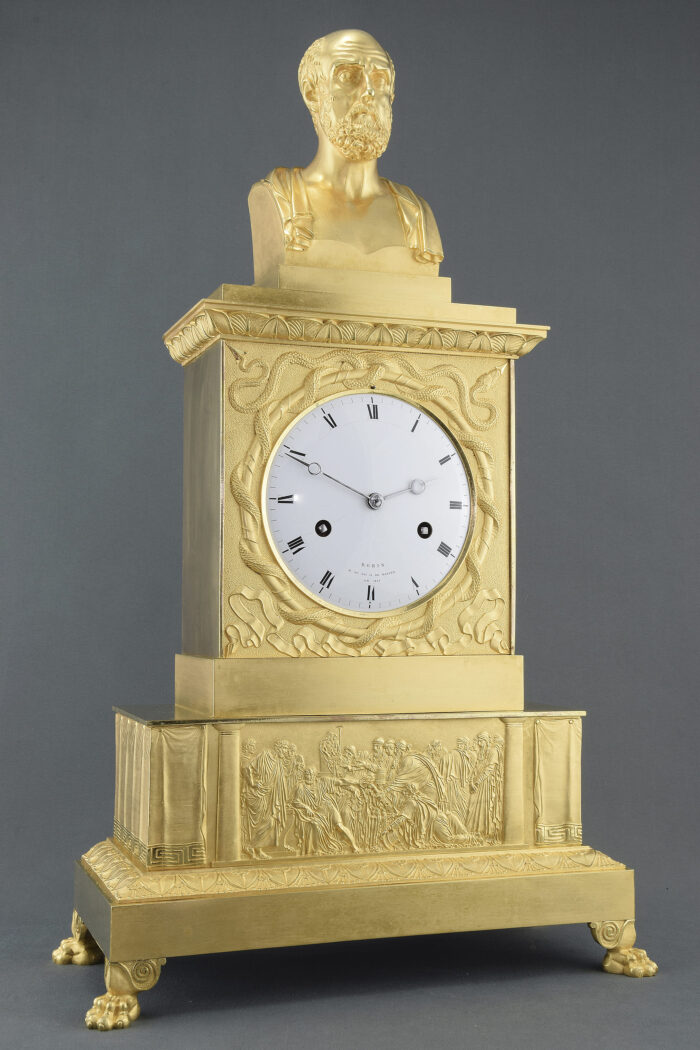
This elegant clock, crafted in patinated and mercury-gilt bronze during the Charles X period (circa 1840), is distinguished by its monumental, Neoclassical-inspired architecture, where rigorous lines blend with the nobility of Antiquity. The piece features a perfectly balanced vertical composition, dominated by an imposing bust of Homer that crowns the clock body, lending the work a remarkable intellectual and symbolic presence.
At the summit sits the famous Greek poet Homer, depicted as a bust following traditional iconography inherited from ancient models. His head is slightly turned, infusing the composition with subtle movement. His face conveys the wisdom, contemplation, and spiritual depth associated with the father of the Greek epic. A broad, powerfully modeled forehead, pronounced brow ridges, deep-set eyes, a strong nose, and a slightly parted mouth give the figure a meditative intensity. The abundant beard, rendered in long, undulating locks, demonstrates exceptional chasing quality. His hair, arranged in large, soft curls, is held back by an antique-style headband that further emphasizes the subject's classical lineage. The deliberately understated modeling of the torso highlights the expressive power of the face and evokes the ancient busts found in major European collections.
The bust rests on a rectangular base that serves as a transition to the clock case. The case itself takes the architectural form of a square pillar with smooth, restrained surfaces; its slender proportions evoke an ancient pedestal. The upper section is defined by a wide, projecting cornice adorned with deeply chased lanceolate leaf motifs, reminiscent of the anthemion and palmette…
This elegant clock, crafted in patinated and mercury-gilt bronze during the Charles X period (circa 1840), is distinguished by its monumental, Neoclassical-inspired architecture, where rigorous lines blend with the nobility of Antiquity. The piece features a perfectly balanced vertical composition, dominated by an imposing bust of Homer that crowns the clock body, lending the work a remarkable intellectual and symbolic presence.
At the summit sits the famous Greek poet Homer, depicted as a bust following traditional iconography inherited from ancient models. His head is slightly turned, infusing the composition with subtle movement. His face conveys the wisdom, contemplation, and spiritual depth associated with the father of the Greek epic. A broad, powerfully modeled forehead, pronounced brow ridges, deep-set eyes, a strong nose, and a slightly parted mouth give the figure a meditative intensity. The abundant beard, rendered in long, undulating locks, demonstrates exceptional chasing quality. His hair, arranged in large, soft curls, is held back by an antique-style headband that further emphasizes the subject's classical lineage. The deliberately understated modeling of the torso highlights the expressive power of the face and evokes the ancient busts found in major European collections.
The bust rests on a rectangular base that serves as a transition to the clock case. The case itself takes the architectural form of a square pillar with smooth, restrained surfaces; its slender proportions evoke an ancient pedestal. The upper section is defined by a wide, projecting cornice adorned with deeply chased lanceolate leaf motifs, reminiscent of the anthemion and palmette friezes found in Greek architecture.
A circular dial with Roman numerals is set into the center of the front face. It is set within a wide, ornamental patinated bronze frame featuring a finely carved foliate wreath; the deeply veined leaves create a striking contrast against the dial’s gilded background. This interplay between the brown patina and the gleam of the gilding enhances the piece's decorative richness while maintaining the restraint characteristic of the Charles X style. Delicate mercury-gilded bronze mounts—depicting laurel and foliage wreaths tied with flowing ribbons—adorn the four corners of the dial. Their exceptionally fine chasing reveals intricate details in the leaves, berries, and knots, showcasing the mastery of Parisian bronze-makers from the first third of the 19th century. These botanical motifs—symbols of glory, immortality, and poetic genius—harmonize naturally with the figure of Homer positioned at the summit.
The lower section of the body is defined by substantial molding decorated with a frieze of palmettes and stylized relief motifs. This ornamental band creates a harmonious transition to the base. The rectangular lower plinth features intentionally clean lines that highlight the quality of the antique-brown patina. It rests on four rectangular feet adorned with rosettes and floral motifs, finely chased within patinated bronze reserves.
The piece captivates through the exceptional quality of its sculpting and chasing. The bronze’s deep brown patina accentuates the contours of the bust and the clock’s architectural form, while the mercury-gilded bronze elements provide luminous, highly elegant accents. With its scholarly subject matter, decorative vocabulary drawn from Antiquity, and noble materials, this clock stands as a remarkable testament to the Neoclassical taste prevalent during the late Charles X period and the early years of Louis-Philippe’s reign—a time when admiration for Greek civilization continued to inspire the finest creations of French artistic clockmaking.
Original, unmodified movement with silk-thread suspension. Strikes the hours and half-hours on an antique bell, producing a clear, authentic tone.
This website uses cookies to ensure you get the best experience on our website.
Functional Always active
The technical storage or access is strictly necessary for the legitimate interest purpose of enabling the use of a specific service explicitly requested by the subscriber or user, or for the sole purpose of carrying out the transmission of a communication over an electronic communications network.
Preferences
The technical storage or access is necessary for the legitimate purpose of storing preferences that are not requested by the subscriber or user.
Statistiques
The technical storage or access that is used exclusively for statistical purposes.Le stockage ou l’accès technique qui est utilisé exclusivement à des fins statistiques anonymes. En l’absence d’une assignation à comparaître, d’une conformité volontaire de la part de votre fournisseur d’accès à internet ou d’enregistrements supplémentaires provenant d’un tiers, les informations stockées ou extraites à cette seule fin ne peuvent généralement pas être utilisées pour vous identifier.
Marketing
The technical storage or access is required to create user profiles in order to send advertising, or to track the user on a website or across several websites for similar marketing purposes.

 Discover this piece
 Discover this piece
 Discover this piece
 Discover this piece
 Discover this piece
 Discover this piece
 Discover this piece
 Discover this piece
 Discover this piece
 Discover this piece
 Discover this piece
 Discover this piece
 Discover this piece
 Discover this piece
 Discover this piece