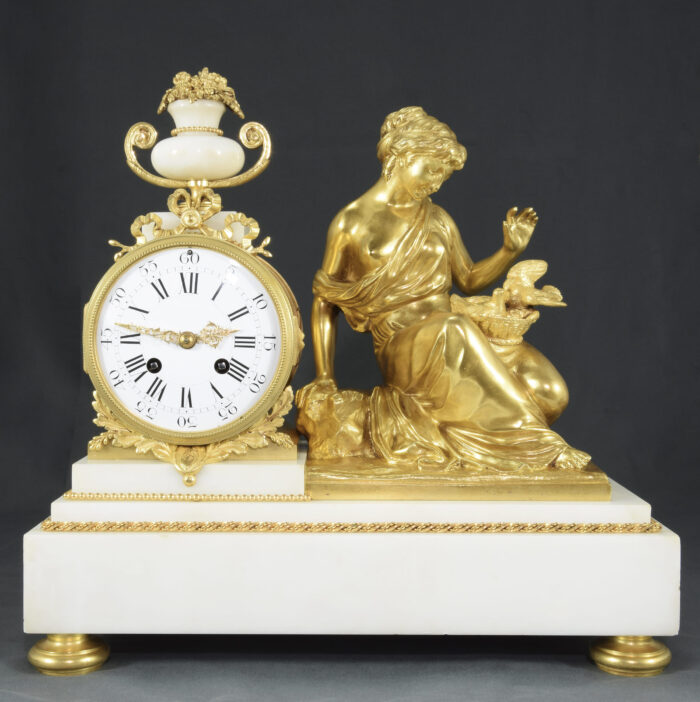
This elegant Louis XVI-style mantel clock, crafted during the Second Empire around 1860, exquisitely combines the purity of Carrara marble with the brilliance of finely chased gilt bronze. Its perfectly symmetrical architecture draws upon the Neoclassical decorative vocabulary of the 18th century, reinterpreted with the ornamental richness characteristic of the Napoleon III era.
The piece is crowned by a delicate white marble tazza resting on a gilt-bronze pedestal base. This antique-style vessel is accented by a beaded frieze and embellished with fine chains suspended between side rings. Its lid is topped with a bouquet of stylized leaves and fruit, evoking abundance and prosperity.
Beneath this cassolette lies a square marble plinth bordered by a row of gilt beads, marking the transition to the clock’s main body. The circular white enamel dial forms the center of the composition. It is set within a gilt-bronze bezel decorated with a twisted molding reminiscent of antique cordage. Elegantly drawn black Arabic numerals stand out sharply against the white background. The openwork gilt-bronze hands feature delicate foliate ornamentation typical of the Louis XVI repertoire. The movement is housed in a cylindrical drum, the sides of which are decorated with concentric fluting and finely chased moldings. Flanking the dial are two remarkable mounts depicting eagle necks. These powerful birds-of-prey heads, sculpted with great naturalism, display richly detailed plumage in which every feather is finely chased. The hooked beaks hold a movable chain forming an elegant garland. The long necks extend into foliate forms that terminate in scrolls evoking stylized talons.
These…
This elegant Louis XVI-style mantel clock, crafted during the Second Empire around 1860, exquisitely combines the purity of Carrara marble with the brilliance of finely chased gilt bronze. Its perfectly symmetrical architecture draws upon the Neoclassical decorative vocabulary of the 18th century, reinterpreted with the ornamental richness characteristic of the Napoleon III era.
The piece is crowned by a delicate white marble tazza resting on a gilt-bronze pedestal base. This antique-style vessel is accented by a beaded frieze and embellished with fine chains suspended between side rings. Its lid is topped with a bouquet of stylized leaves and fruit, evoking abundance and prosperity.
Beneath this cassolette lies a square marble plinth bordered by a row of gilt beads, marking the transition to the clock’s main body. The circular white enamel dial forms the center of the composition. It is set within a gilt-bronze bezel decorated with a twisted molding reminiscent of antique cordage. Elegantly drawn black Arabic numerals stand out sharply against the white background. The openwork gilt-bronze hands feature delicate foliate ornamentation typical of the Louis XVI repertoire. The movement is housed in a cylindrical drum, the sides of which are decorated with concentric fluting and finely chased moldings. Flanking the dial are two remarkable mounts depicting eagle necks. These powerful birds-of-prey heads, sculpted with great naturalism, display richly detailed plumage in which every feather is finely chased. The hooked beaks hold a movable chain forming an elegant garland. The long necks extend into foliate forms that terminate in scrolls evoking stylized talons.
These motifs, inspired by Imperial antiquity, lend strength and majesty to the piece while harmoniously framing the dial. Beneath the dial, a substantial gilt-bronze garland of laurel leaves and berries forms a triumphal wreath. The leaves are rendered with remarkable precision in the chasing, alternating between matte and burnished surfaces that accentuate the play of light. This garland converges on a central ribbon bow with trailing ends—an emblematic Louis XVI motif symbolizing elegance and balance.
The dial rests on a central rectangular column of Carrara marble, entirely framed by a row of gilt beads. This column is flanked by two side pedestals of the same marble, creating an architectural composition with three bays. The front of each pedestal block is adorned with a motif of a ribbon bow and arrow—delicately chased in gilt bronze—another characteristic element of the Neoclassical repertoire. A stepped white marble base anchors the composition’s stability. Its front is enriched with a decorative gilt-bronze frieze featuring a succession of interlaced ovolos and stylized scrolls. At the ends, applied radiating rosettes enliven the stepped sections of the plinth. The entire piece rests on four small turned gilt-bronze feet, whose subtle chasing ensures a harmonious transition to the base.
With its high-quality materials, fine gilding, and rich ornamentation—combining antique-style cassolettes, laurel garlands, beadwork, Louis XVI-style bows, and eagle-neck motifs—this clock perfectly exemplifies the Louis XVI style as revisited during the Napoleon III period (circa 1860). It showcases classical elegance enhanced by meticulous craftsmanship and remarkable sculptural and chasing work on the gilt bronze.
Original mechanism intact and unmodified. Strikes the hours and half-hours on an antique bell with a clear, authentic tone.
This website uses cookies to ensure you get the best experience on our website.
Functional Always active
The technical storage or access is strictly necessary for the legitimate interest purpose of enabling the use of a specific service explicitly requested by the subscriber or user, or for the sole purpose of carrying out the transmission of a communication over an electronic communications network.
Preferences
The technical storage or access is necessary for the legitimate purpose of storing preferences that are not requested by the subscriber or user.
Statistiques
The technical storage or access that is used exclusively for statistical purposes.Le stockage ou l’accès technique qui est utilisé exclusivement à des fins statistiques anonymes. En l’absence d’une assignation à comparaître, d’une conformité volontaire de la part de votre fournisseur d’accès à internet ou d’enregistrements supplémentaires provenant d’un tiers, les informations stockées ou extraites à cette seule fin ne peuvent généralement pas être utilisées pour vous identifier.
Marketing
The technical storage or access is required to create user profiles in order to send advertising, or to track the user on a website or across several websites for similar marketing purposes.

 Discover this piece
 Discover this piece
 Discover this piece
 Discover this piece
 Discover this piece
 Discover this piece
 Discover this piece
 Discover this piece
 Discover this piece
 Discover this piece
 Discover this piece
 Discover this piece
 Discover this piece
 Discover this piece
 Discover this piece