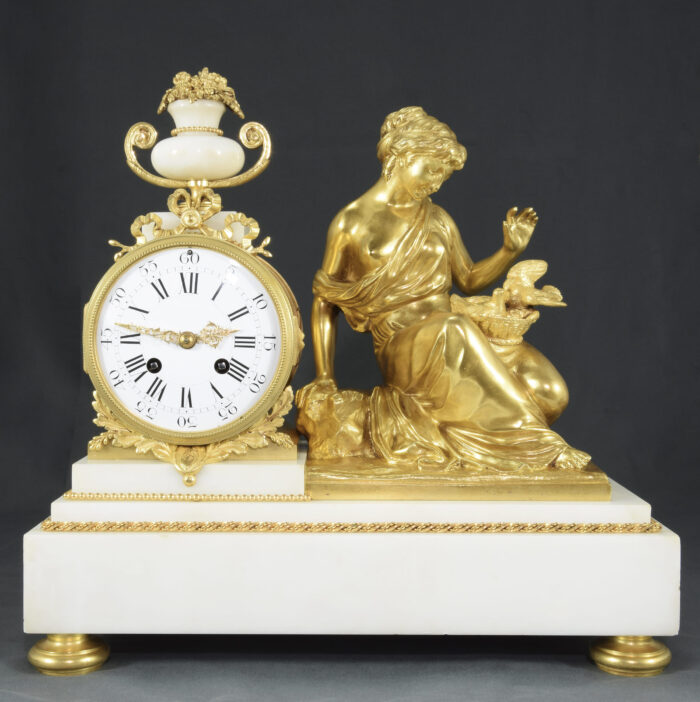
A "Geoffrin-style" mantel clock from the Louis-Philippe period (circa 1850), featuring the maker's stamp—Desfontaines—on the movement; the clockmaker is listed in Tardy’s *Dictionnaire des horlogers français*. Crafted from gilt bronze, patinated bronze, and Carrara marble, the piece displays an elegant, perfectly balanced horizontal composition in the decorative spirit of the Louis XVI style.
The composition is dominated by a majestic female figure in black-patinated bronze—an allegory of Study or Poetry—elegantly reclining on a cushion against the clock's central plinth. Her posture exudes calm and contemplation: her head, slightly tilted, rests on her right hand, while her gaze is gently directed toward an open book held in her left hand, suggesting a moment of quiet reading. Her classically featured face radiates serenity, framed by wavy hair swept up into a chignon and secured by a laurel wreath—a symbol of knowledge and the arts. She wears a long, belted tunic in the antique style, with wide sleeves and abundant folds that drape naturally down the length of her body. The modeling of the drapery is exceptionally refined, alternating between taut folds and deep breaks that highlight the quality of the casting and chasing. A rich decorative frieze adorns the garment's hem. Her legs are elegantly extended; one foot protrudes slightly from the dress, resting naturally on the marble base. Arranged around the figure are various attributes of study: a large open book with richly molded gilt-bronze covers rests on her lap, while a partially unrolled parchment scroll—symbolizing knowledge and the sciences—lies at her feet.
The entire piece rests on a substantial…
A "Geoffrin-style" mantel clock from the Louis-Philippe period (circa 1850), featuring the maker's stamp—Desfontaines—on the movement; the clockmaker is listed in Tardy’s *Dictionnaire des horlogers français*. Crafted from gilt bronze, patinated bronze, and Carrara marble, the piece displays an elegant, perfectly balanced horizontal composition in the decorative spirit of the Louis XVI style.
The composition is dominated by a majestic female figure in black-patinated bronze—an allegory of Study or Poetry—elegantly reclining on a cushion against the clock's central plinth. Her posture exudes calm and contemplation: her head, slightly tilted, rests on her right hand, while her gaze is gently directed toward an open book held in her left hand, suggesting a moment of quiet reading. Her classically featured face radiates serenity, framed by wavy hair swept up into a chignon and secured by a laurel wreath—a symbol of knowledge and the arts. She wears a long, belted tunic in the antique style, with wide sleeves and abundant folds that drape naturally down the length of her body. The modeling of the drapery is exceptionally refined, alternating between taut folds and deep breaks that highlight the quality of the casting and chasing. A rich decorative frieze adorns the garment's hem. Her legs are elegantly extended; one foot protrudes slightly from the dress, resting naturally on the marble base. Arranged around the figure are various attributes of study: a large open book with richly molded gilt-bronze covers rests on her lap, while a partially unrolled parchment scroll—symbolizing knowledge and the sciences—lies at her feet.
The entire piece rests on a substantial rectangular base of white Carrara marble with polished surfaces, accented by projecting sections and rich gilt-bronze molding. The lower plinth is encircled by a finely chased frieze alternating rows of beads, ovolos, and foliate motifs, while four flattened, circular gilt-bronze feet—delicately gadrooned and adorned with water leaves—support the entire structure. Centered on the façade, a wide recessed band features exceptional openwork gilt-bronze ornamentation composed of symmetrical scrolling foliage, leafy volutes, palmettes, grape clusters, and interlaced vine leaves, forming a continuous frieze of exquisite craftsmanship. The corners of the upper platform are defined by a beaded and foliate molding that harmoniously frames the composition.
To the right sits the clock movement, housed within a rectangular, architectural gilt-bronze case; its façade is dominated by a large, circular white enamel dial displaying the hours in black Roman numerals and featuring elegant, finely cut blued-steel hands. The bezel is embellished with a row of beads, while the surrounding frame displays acanthus leaves, palmettes, and volutes. The sides of the case are decorated with an engraved lozenge pattern separated by fluted pilasters, and the top features a molded cornice with foliate decoration. At the rear, the circular movement is housed within a gilt-brass backplate, accessible via a large service opening.
The contrast between the brilliant gilt bronze of the architectural elements and ornaments and the deep, patinated bronze of the sculpture imbues this clock with the rich decorative quality characteristic of fine pieces from the Louis-Philippe era, circa 1850. Through its balanced composition, finely wrought chasing, noble materials, and delicate iconography, this *Goeffrin*-style clock stands as a remarkable example of mid-19th-century French artistic horology, in which sculpture, architecture, and ornamentation unite to create a work of great elegance.
Original movement, intact and unmodified, with thread suspension. The hours and half-hours strike on an antique bell with a clear, authentic tone.
This website uses cookies to ensure you get the best experience on our website.
Functional Always active
The technical storage or access is strictly necessary for the legitimate interest purpose of enabling the use of a specific service explicitly requested by the subscriber or user, or for the sole purpose of carrying out the transmission of a communication over an electronic communications network.
Preferences
The technical storage or access is necessary for the legitimate purpose of storing preferences that are not requested by the subscriber or user.
Statistiques
The technical storage or access that is used exclusively for statistical purposes.Le stockage ou l’accès technique qui est utilisé exclusivement à des fins statistiques anonymes. En l’absence d’une assignation à comparaître, d’une conformité volontaire de la part de votre fournisseur d’accès à internet ou d’enregistrements supplémentaires provenant d’un tiers, les informations stockées ou extraites à cette seule fin ne peuvent généralement pas être utilisées pour vous identifier.
Marketing
The technical storage or access is required to create user profiles in order to send advertising, or to track the user on a website or across several websites for similar marketing purposes.

 Discover this piece
 Discover this piece
 Discover this piece
 Discover this piece
 Discover this piece
 Discover this piece
 Discover this piece
 Discover this piece
 Discover this piece
 Discover this piece
 Discover this piece
 Discover this piece
 Discover this piece
 Discover this piece
 Discover this piece