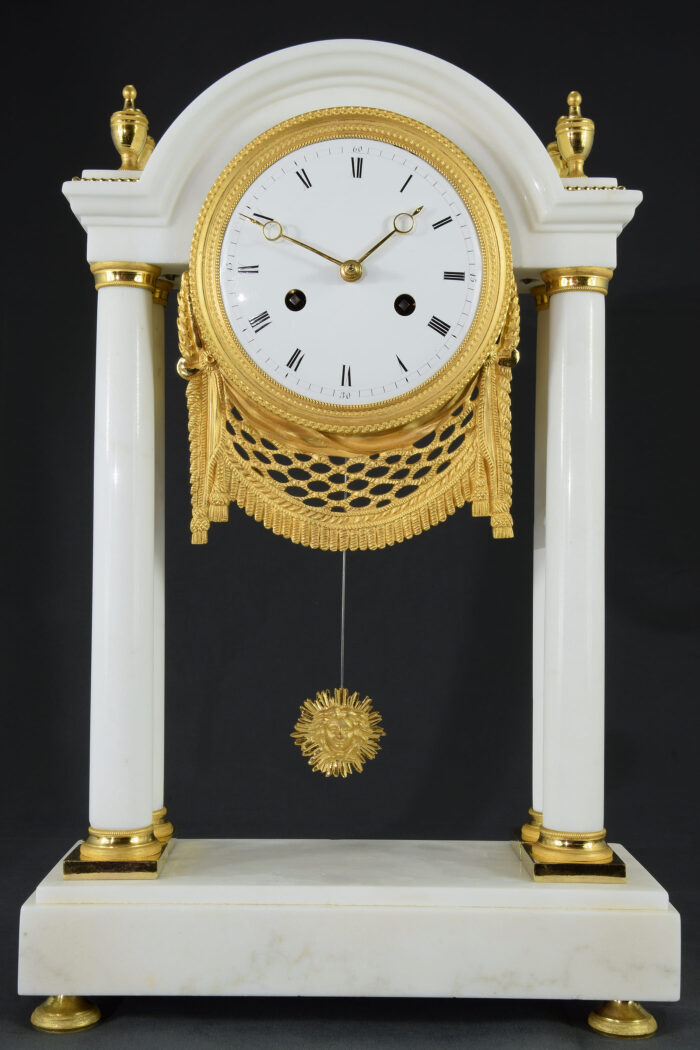
Cette pendule portique évoquant la façade d’un temple antique d’époque Empire, se distingue par la noblesse de ses matériaux et la finesse exceptionnelle de sa ciselure. Réalisée en marbre blanc immaculé et ornée de bronzes dorés au mercure à l’or d’une qualité remarquable, elle incarne avec éclat le goût néoclassique inspiré de l’Antiquité.
Resting on a rectangular marble base, the plinth, delicately highlighted by a beaded frieze, is embellished on the front with two finely chased appliqués decorated with points and gadroons, framing a radiant central floral motif, a symbol of harmony and perfection. The toupie feet ensure the piece's stability while adding a precious and refined touch. From this base rise two perfectly proportioned cylindrical columns of white marble, topped with capitals and bases of finely guillochéd gilt bronze. These columns evoke classical architecture and lend the clock the appearance of a veritable temple portico, emphasizing the verticality and solemnity of the composition.
Between these supports sits the circular dial, encircled by a gilt-bronze bezel richly engraved with concentric friezes. The pristine white enamel dial is adorned with black Roman numerals and finely openworked hands. It is signed "Thiaffait à Lyon," a clockmaker listed as early as 1810 in Tardy's dictionary of French clockmakers, a guarantee of authenticity and horological quality. Below the dial, a delicate openwork drapery in gilt-bronze, executed with exquisite finesse, evokes antique tapestries and accentuates the theatrical character of the piece. Suspended at its center, the finely chiseled, lenticular pendulum in gilt bronze, depicting an antique vase of…
Cette pendule portique évoquant la façade d’un temple antique d’époque Empire, se distingue par la noblesse de ses matériaux et la finesse exceptionnelle de sa ciselure. Réalisée en marbre blanc immaculé et ornée de bronzes dorés au mercure à l’or d’une qualité remarquable, elle incarne avec éclat le goût néoclassique inspiré de l’Antiquité.
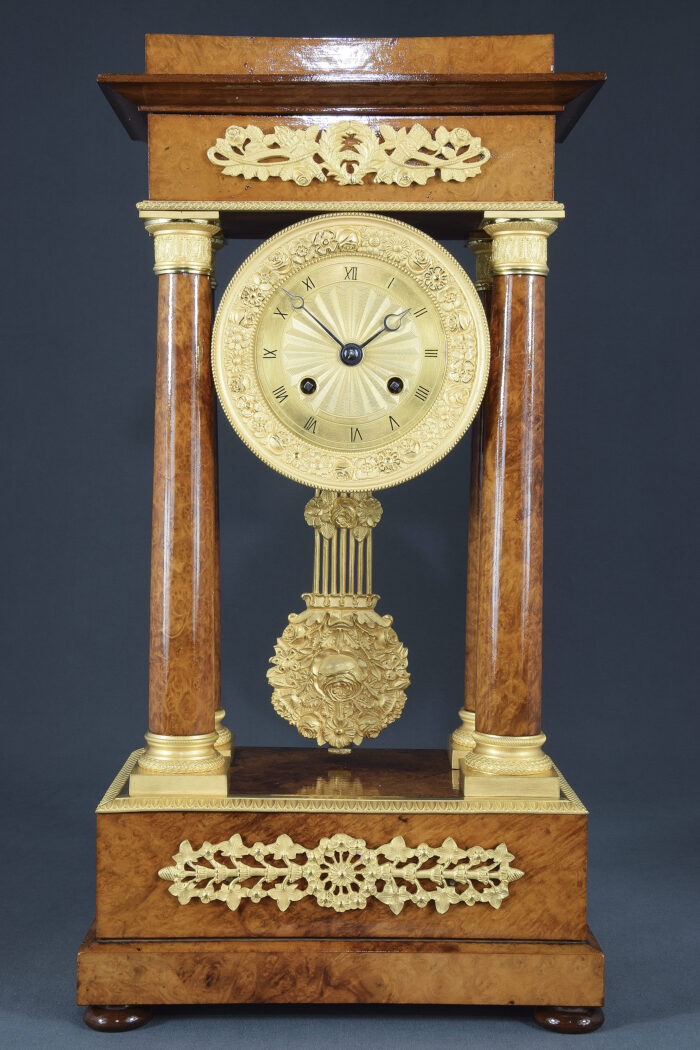
Resting on a rectangular marble base, the plinth, delicately highlighted by a beaded frieze, is embellished on the front with two finely chased appliqués decorated with points and gadroons, framing a radiant central floral motif, a symbol of harmony and perfection. The toupie feet ensure the piece's stability while adding a precious and refined touch. From this base rise two perfectly proportioned cylindrical columns of white marble, topped with capitals and bases of finely guillochéd gilt bronze. These columns evoke classical architecture and lend the clock the appearance of a veritable temple portico, emphasizing the verticality and solemnity of the composition.
Between these supports sits the circular dial, encircled by a gilt-bronze bezel richly engraved with concentric friezes. The pristine white enamel dial is adorned with black Roman numerals and finely openworked hands. It is signed "Thiaffait à Lyon," a clockmaker listed as early as 1810 in Tardy's dictionary of French clockmakers, a guarantee of authenticity and horological quality. Below the dial, a delicate openwork drapery in gilt-bronze, executed with exquisite finesse, evokes antique tapestries and accentuates the theatrical character of the piece. Suspended at its center, the finely chiseled, lenticular pendulum in gilt bronze, depicting an antique vase of flowers—a symbol of abundance and renewal—animates the composition with grace and lightness, while offering a highly refined visual focal point.
La partie supérieure est couronnée d’un entablement en marbre surmonté d’un fronton triangulaire, richement orné. Une tête féminine ailée, probablement une allégorie de la Victoire ou de la Renommée, trône au centre, encadrée de cornes d’abondance. Ces ornements, d’une précision remarquable, témoignent du savoir-faire des bronziers de l’époque et confèrent à l’ensemble une dimension symbolique forte, entre triomphe, beauté et éternité. L’ensemble compose ainsi une véritable façade monumentale miniature, où chaque élément architectural et décoratif dialogue avec harmonie. Cette pendule portique illustre avec éclat l’excellence des arts décoratifs sous l’Empire, alliant rigueur classique, richesse ornementale et virtuosité technique. Une pièce de collection à la fois décorative et historique.
Original movement intact and unaltered, with silk-thread suspension. Striking on the hours and half-hours on an antique bell, producing a clear and authentic tone.
This website uses cookies to ensure you get the best experience on our website.
Functional Always active
The technical storage or access is strictly necessary for the legitimate interest purpose of enabling the use of a specific service explicitly requested by the subscriber or user, or for the sole purpose of carrying out the transmission of a communication over an electronic communications network.
Preferences
The technical storage or access is necessary for the legitimate purpose of storing preferences that are not requested by the subscriber or user.
Statistiques
The technical storage or access that is used exclusively for statistical purposes.Le stockage ou l’accès technique qui est utilisé exclusivement à des fins statistiques anonymes. En l’absence d’une assignation à comparaître, d’une conformité volontaire de la part de votre fournisseur d’accès à internet ou d’enregistrements supplémentaires provenant d’un tiers, les informations stockées ou extraites à cette seule fin ne peuvent généralement pas être utilisées pour vous identifier.
Marketing
The technical storage or access is required to create user profiles in order to send advertising, or to track the user on a website or across several websites for similar marketing purposes.

 Discover this piece
 Discover this piece
 Discover this piece
 Discover this piece
 Discover this piece
 Discover this piece
 Discover this piece
 Discover this piece
 Discover this piece
 Discover this piece
 Discover this piece
 Discover this piece
 Discover this piece
 Discover this piece
 Discover this piece