Remarquable pendule d’époque Louis-Philippe (vers 1850-1860), cette œuvre raffinée s’inscrit dans le goût historiciste du XIXe siècle en puisant son inspiration dans l’esthétique de la Renaissance. Elle développe une véritable scène narrative, à la fois intime et érudite, où l’architecture en bronze doré au mercure à l’or sert d’écrin à une évocation poétique du savoir, de l’écriture et des arts.
The composition is organized around a stylized Renaissance study or study, subtly suggested by the presence of a finely crafted lockbox placed atop the clock. This small, symbolic piece, treated like a precious chest, evokes the preservation of letters, secrets, or intimate thoughts. Beside it, an inkwell topped with a quill completes this scholarly world, embodying the act of writing, transmitting, and creating.
A richly dressed female figure, inspired by the elegance of the Renaissance in the style of the 16th century. Draped in a gown with ample, meticulously carved folds, she adopts a graceful and meditative pose, holding a letter in a suspended gesture, as if caught in the act of reading or in the moment before the reply—a subtle allegory of correspondence, intellect, or discreet love. Her serene face, with its idealized features, is framed by a finely ornamented headdress, while the treatment of the costume reveals remarkable craftsmanship: embroidery, braid, floral motifs, and textile textures are rendered with exceptional precision.
The enamel dial integrates harmoniously into this setting, framed by architectural and ornamental motifs inspired by the Renaissance: beaded friezes, scrolls, cartouches, and volutes compose a rich yet perfectly balanced decoration.
In…
Remarquable pendule d’époque Louis-Philippe (vers 1850-1860), cette œuvre raffinée s’inscrit dans le goût historiciste du XIXe siècle en puisant son inspiration dans l’esthétique de la Renaissance. Elle développe une véritable scène narrative, à la fois intime et érudite, où l’architecture en bronze doré au mercure à l’or sert d’écrin à une évocation poétique du savoir, de l’écriture et des arts.
The composition is organized around a stylized Renaissance study or study, subtly suggested by the presence of a finely crafted lockbox placed atop the clock. This small, symbolic piece, treated like a precious chest, evokes the preservation of letters, secrets, or intimate thoughts. Beside it, an inkwell topped with a quill completes this scholarly world, embodying the act of writing, transmitting, and creating.
A richly dressed female figure, inspired by the elegance of the Renaissance in the style of the 16th century. Draped in a gown with ample, meticulously carved folds, she adopts a graceful and meditative pose, holding a letter in a suspended gesture, as if caught in the act of reading or in the moment before the reply—a subtle allegory of correspondence, intellect, or discreet love. Her serene face, with its idealized features, is framed by a finely ornamented headdress, while the treatment of the costume reveals remarkable craftsmanship: embroidery, braid, floral motifs, and textile textures are rendered with exceptional precision.
The enamel dial integrates harmoniously into this setting, framed by architectural and ornamental motifs inspired by the Renaissance: beaded friezes, scrolls, cartouches, and volutes compose a rich yet perfectly balanced decoration.
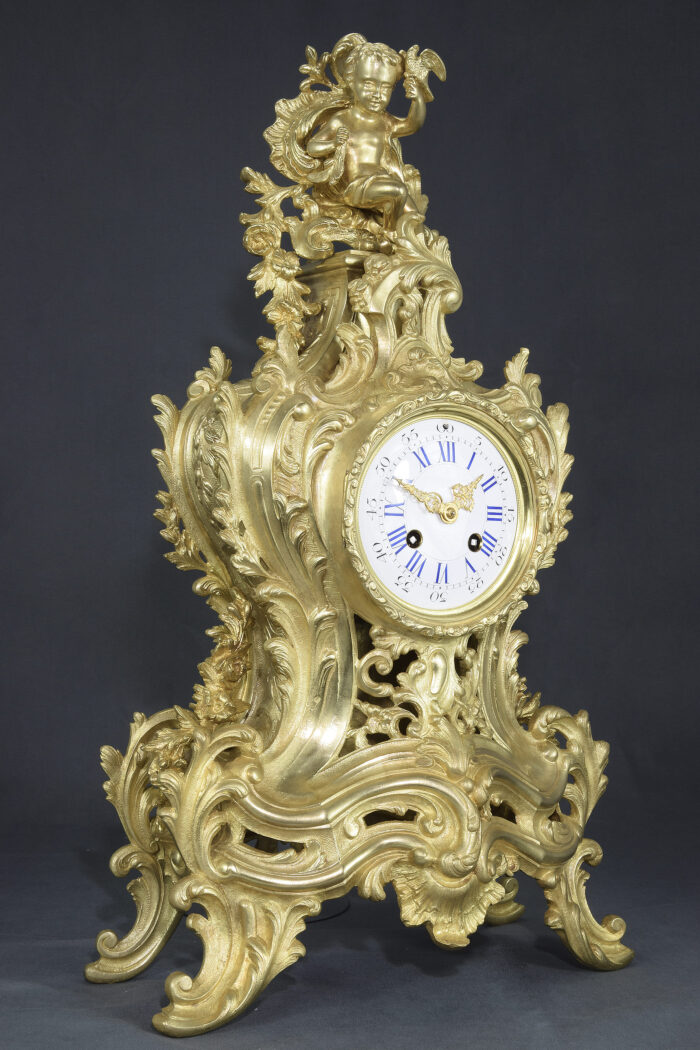
In the lower section, the piece rests on a flowing base with generous scrolls, punctuated by volute-shaped brackets and richly sculpted vegetal ornamentation. A delicately modeled winged putto, seated at the heart of a decorative trophy, plays a stringed instrument. He is surrounded by scholarly attributes—globes, books, instruments—forming an allegory of the arts and sciences. This lower register engages in a dialogue with the upper scene, creating a thematic continuity between music, study, and writing.
The quality of execution is remarkable: the extremely fine chasing highlights every detail, from the textile textures to the most minute decorative elements. The mercury gilding provides a warm and deep light, characteristic of high-quality art bronzes.
Technically, the movement is stamped "Vincenti et Cie," a prestigious watchmaking house listed in Tardy's dictionary of watchmakers, a guarantee of authenticity and reliability. This signature attests to a highly precise mechanism, typical of the finest French production of the period.
This clock is more than just a timekeeping instrument: it tells a story. It depicts a moment suspended in an idealized study, where a young woman, pen and letter in hand, embodies the spirit of the Renaissance as revisited by the 19th century—a sensitive tribute to knowledge, intimacy, and timeless elegance.
Original movement intact and unaltered, with silk-thread suspension. Striking on the hours and half-hours on an antique bell, producing a clear and authentic tone.
This website uses cookies to ensure you get the best experience on our website.
Functional Always active
The technical storage or access is strictly necessary for the legitimate interest purpose of enabling the use of a specific service explicitly requested by the subscriber or user, or for the sole purpose of carrying out the transmission of a communication over an electronic communications network.
Preferences
The technical storage or access is necessary for the legitimate purpose of storing preferences that are not requested by the subscriber or user.
Statistiques
The technical storage or access that is used exclusively for statistical purposes.Le stockage ou l’accès technique qui est utilisé exclusivement à des fins statistiques anonymes. En l’absence d’une assignation à comparaître, d’une conformité volontaire de la part de votre fournisseur d’accès à internet ou d’enregistrements supplémentaires provenant d’un tiers, les informations stockées ou extraites à cette seule fin ne peuvent généralement pas être utilisées pour vous identifier.
Marketing
The technical storage or access is required to create user profiles in order to send advertising, or to track the user on a website or across several websites for similar marketing purposes.

 Discover this piece
 Discover this piece
 Discover this piece
 Discover this piece
 Discover this piece
 Discover this piece
 Discover this piece
 Discover this piece
 Discover this piece
 Discover this piece
 Discover this piece
 Discover this piece
 Discover this piece
 Discover this piece
 Discover this piece