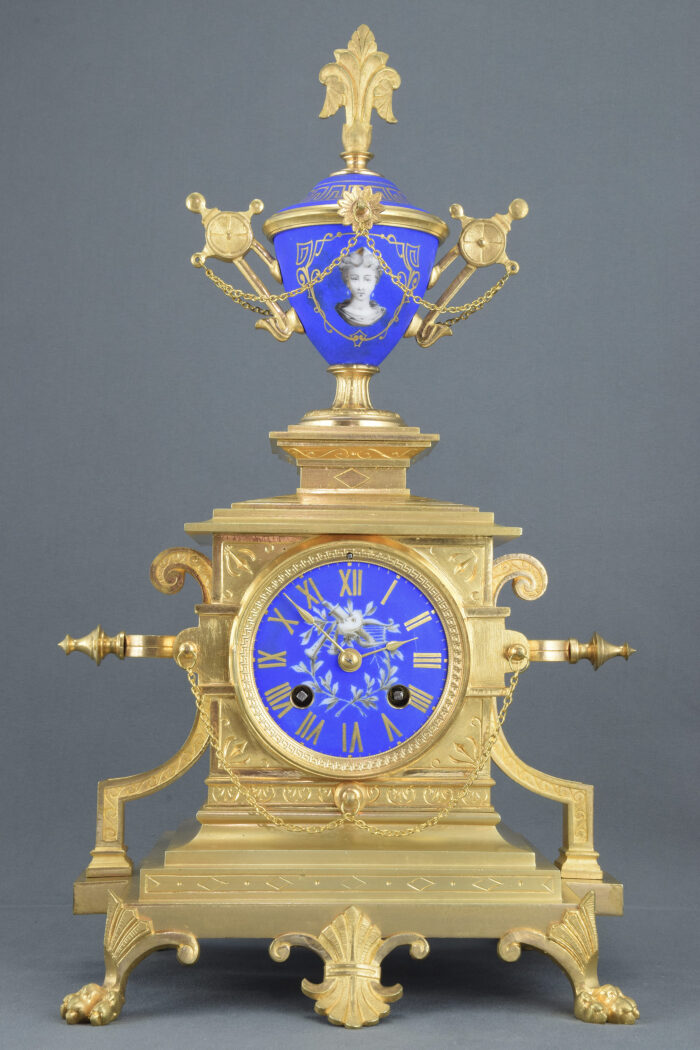
Made around 1860, during the reign of Napoleon III, this mantel garniture brings together a clock and a pair of candelabra in the Louis XVI taste. Crafted entirely from chased and gilt bronze, it is enriched with white onyx panels whose delicate veins are faintly visible through the stone. The clock bears the signature “Bozzo Governore à Angers” on both its dial and its movement. The clockmaker is listed under the year 1850 in Tardy’s *Dictionnaire des horlogers*.
The elegance of the set lies entirely in the balance of its proportions. The candelabra rise only slightly above the clock, extending its silhouette with their candle arms. All three pieces share the same onyx vase with geometric handles, the same row of beading around the ornaments and, on the front of each plinth, a gilt palmette that stands out against the white stone. These recurring motifs, down to the smallest details, give the three pieces a remarkable unity.
At the top of the clock, a bronze flame crowns a lidded vase whose onyx body rests in a gadrooned bowl. Below it, a beaded bezel frames the white stone dial, across which two tapered hands sweep over the engraved and gilded Roman numerals. Beneath the dial, a laurel garland hangs in swags before two small columns, then meets the broad scrolls that curl on either side of the case. At the base, a palmette unfurls at the center of a beaded onyx cartouche. Four small top-shaped feet raise the plinth slightly.
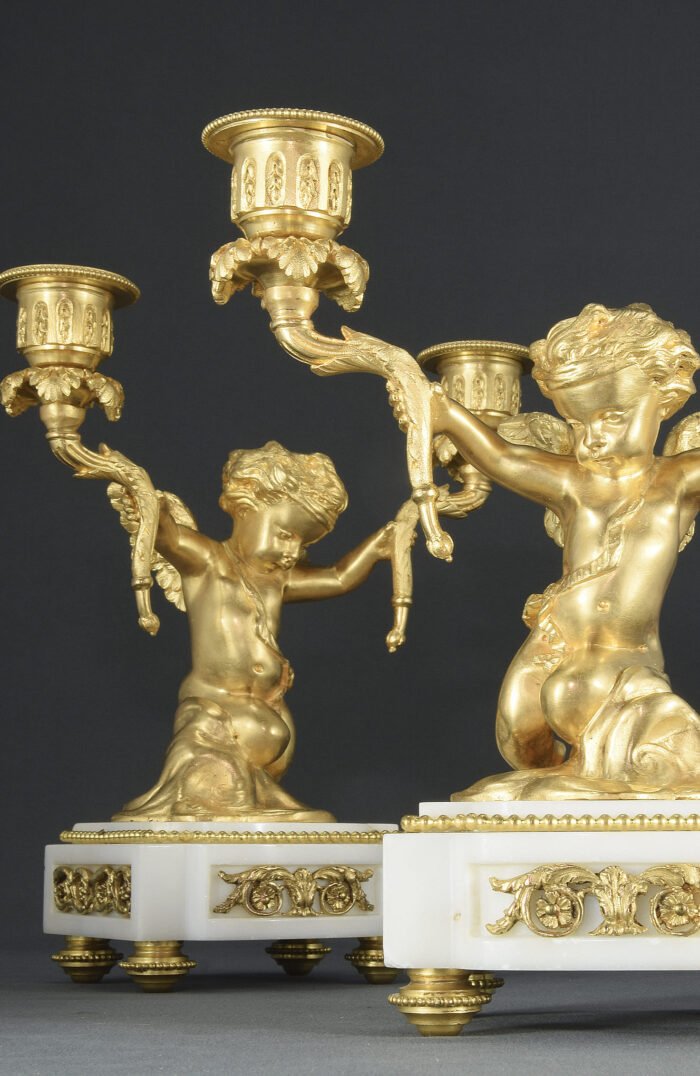
At the top of each candelabrum, a chalice-shaped candle socket rises above the side arms, whose foliate curves carry drip pans and candle sockets with beaded rims. Farther down, the stem flares around a white onyx drum flanked by two…
Made around 1860, during the reign of Napoleon III, this mantel garniture brings together a clock and a pair of candelabra in the Louis XVI taste. Crafted entirely from chased and gilt bronze, it is enriched with white onyx panels whose delicate veins are faintly visible through the stone. The clock bears the signature “Bozzo Governore à Angers” on both its dial and its movement. The clockmaker is listed under the year 1850 in Tardy’s *Dictionnaire des horlogers*.
The elegance of the set lies entirely in the balance of its proportions. The candelabra rise only slightly above the clock, extending its silhouette with their candle arms. All three pieces share the same onyx vase with geometric handles, the same row of beading around the ornaments and, on the front of each plinth, a gilt palmette that stands out against the white stone. These recurring motifs, down to the smallest details, give the three pieces a remarkable unity.
At the top of the clock, a bronze flame crowns a lidded vase whose onyx body rests in a gadrooned bowl. Below it, a beaded bezel frames the white stone dial, across which two tapered hands sweep over the engraved and gilded Roman numerals. Beneath the dial, a laurel garland hangs in swags before two small columns, then meets the broad scrolls that curl on either side of the case. At the base, a palmette unfurls at the center of a beaded onyx cartouche. Four small top-shaped feet raise the plinth slightly.
At the top of each candelabrum, a chalice-shaped candle socket rises above the side arms, whose foliate curves carry drip pans and candle sockets with beaded rims. Farther down, the stem flares around a white onyx drum flanked by two right-angled handles, echoing the vase that crowns the clock. Beneath the stone, the support opens into pierced brackets and ends in acanthus scrolls. A molded platform, decorated at the front with the same palmette as the clock, rests on small turned feet.
For the lover of antique horology, the appeal of this garniture lies as much in the authenticity of its clock as in the quality of the bronzes that accompany it. The clock retains its original gilding and its signed movement. Up close, one can appreciate the finesse with which the chaser shaped each laurel leaf. From a few steps away, it is the harmony of the three silhouettes, the warmth of the gold and the softness of the onyx that give this garniture its presence on a mantelpiece.
Dimensions — Clock: height 37 cm, width 27 cm, depth 12 cm. Candelabrum: height 38 cm, width 18 cm.
This website uses cookies to ensure you get the best experience on our website.
Functional Always active
The technical storage or access is strictly necessary for the legitimate interest purpose of enabling the use of a specific service explicitly requested by the subscriber or user, or for the sole purpose of carrying out the transmission of a communication over an electronic communications network.
Preferences
The technical storage or access is necessary for the legitimate purpose of storing preferences that are not requested by the subscriber or user.
Statistiques
The technical storage or access that is used exclusively for statistical purposes.Le stockage ou l’accès technique qui est utilisé exclusivement à des fins statistiques anonymes. En l’absence d’une assignation à comparaître, d’une conformité volontaire de la part de votre fournisseur d’accès à internet ou d’enregistrements supplémentaires provenant d’un tiers, les informations stockées ou extraites à cette seule fin ne peuvent généralement pas être utilisées pour vous identifier.
Marketing
The technical storage or access is required to create user profiles in order to send advertising, or to track the user on a website or across several websites for similar marketing purposes.

 Discover this piece
 Discover this piece
 Discover this piece
 Discover this piece
 Discover this piece
 Discover this piece
 Discover this piece
 Discover this piece
 Discover this piece
 Discover this piece
 Discover this piece
 Discover this piece
 Discover this piece
 Discover this piece
 Discover this piece